
Do you have a people problem or a structural one?
A business that feels harder to run than it should. Progress is uneven. Roles consume more energy than expected. The same problems reappear despite capable people and repeated effort. A small number of individuals carry far too much load just to keep things moving.
What’s labeled as a people problem is often this: the work is misaligned with the way humans actually operate
Why Capable People Struggle in “Reasonable” Roles
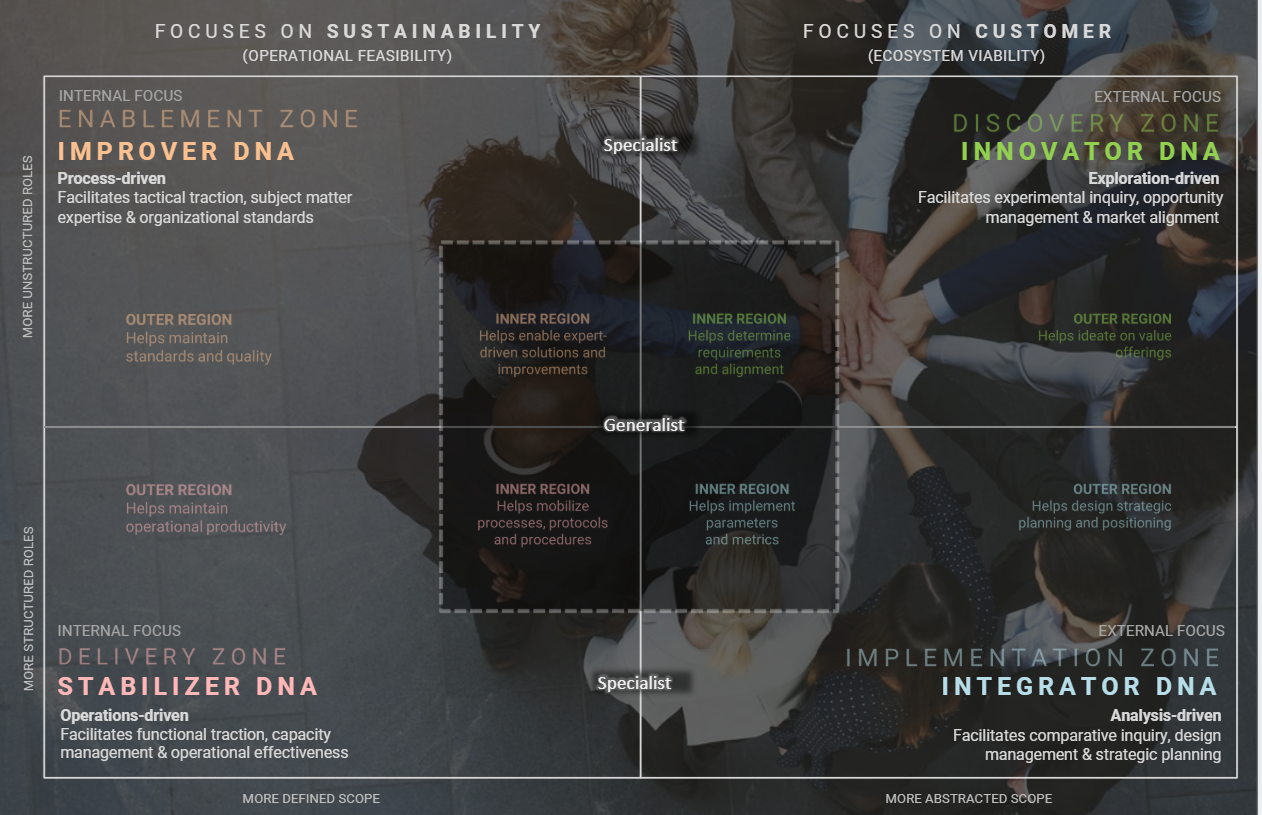
Every organization has four distinct modes of work. Many roles have goals and work that demand all four. Most humans are wired for one or two. Within that, they further gravitate toward specialization or generalist work, creating an “operational signature,” or DNA, that clearly shows where they will thrive. Roles that require opposing zones or are at odds with a person’s DNA are guaranteed to cause problems.
Operational Zones & DNA
PSI: A Data-backed Solution to Identify and Correct Misalignment
The Position Success Indicator (PSI) is a patented, quantitative diagnostic approach used by investors, growth-stage companies and the Fortune 10 to answer specific questions:
Is this work designed in a way real people can execute reliably, without constant intervention or heroics?
How well does this candidate/employee fit with this role/work (or where do they fit?)
How well does this person/supervisor/team fit?
PSI does not measure personality, behaviors, motivation or values. It measures how people operate at work and maps that reality to:
The actual work being done
How roles are constructed and goals measured
How responsibilities overlap, conflict or go uncovered
Where execution is structurally unsupported or at odds with strategy
The data behind a PSI assessment distinguishes people issues from design problems – without judgement – and makes execution risk visible by showing whether people, roles and teams are structurally capable of delivering what the business is asking of them.
- Roles feel unmanageable even when the person is skilled
- Collaboration creates friction instead of leverage
- Replacing a “problem hire” does not resolve the issue
- Execution slows as complexity increases
- Leadership bandwidth keeps collapsing
Why Use PSI?
Character assessments and skills tests can yield interesting insights into candidates and teams, but the view is limited. When structural problems are treated as human failures, organizations pay dearly. Leaders absorb load the system should be carrying. Capable people disengage or leave. Momentum erodes as the same issues resurface with different names.
PSI interrupts that cycle by making the underlying structure visible and actionable.
The goal is not to fix people. It’s to create conditions where capable people can actually succeed.
We use PSI to examine execution at the candidate/employee, role and team levels:
Pressure-test roles before (and after) hiring
Assess a candidate’s fit to the role, supervisor and team
Diagnose recurring execution breakdowns anywhere in the business
Understand why progress stalls despite effort and competence
Separate structural problems from people problems
Inform decisions about redesign, sequencing and focus